
Ductile Iron vs Gray Iron: Choose by Load, Not by Habit
Publication Date : 2026-10-13 16:24:52
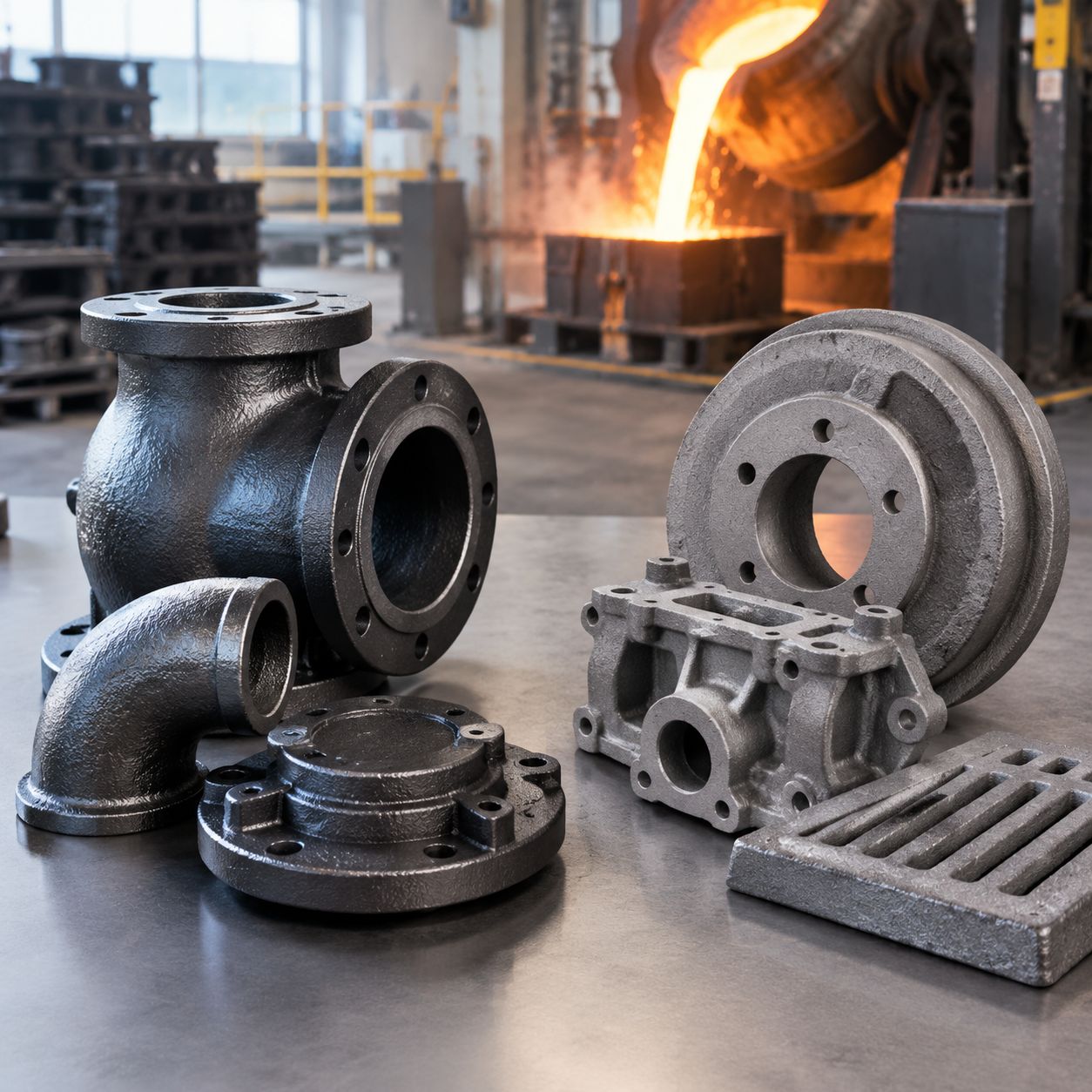
A practical guide for B2B casting buyers comparing ductile iron and gray iron on tensile strength, damping, cost, and typical applications. Learn how to select the right material based on load conditions, not tradition.
Strength and Load-Bearing Capacity
When specifying iron castings, the first question should be: what loads will this part actually see? Ductile iron (also called nodular iron) offers tensile strength typically ranging from 60,000 to 120,000 psi (414–827 MPa), depending on grade. Common grades like 65-45-12 provide 65,000 psi tensile and 45,000 psi yield. In contrast, gray iron grades such as Class 30 or Class 40 have tensile strengths between 30,000 and 40,000 psi (207–276 MPa). That means ductile iron can be two to four times stronger in tension, making it the clear choice for high-stress applications like suspension components, hydraulic housings, and gears.
However, strength alone doesn't tell the whole story. Gray iron excels in compression and has excellent machinability. For parts that mainly experience compressive loads—such as machine tool bases, engine blocks, and large frames—gray iron's lower tensile strength is rarely a limitation. The key is to match the material to the dominant stress mode: tension, bending, or compression. If your part sees significant bending or shock loads, ductile iron's higher yield strength and elongation (typically 2–18%) prevent brittle failure. Gray iron, with near-zero elongation, will crack under impact.
Damping, Vibration, and Thermal Conductivity
Gray iron's secret weapon is its damping capacity. The flake graphite structure absorbs vibration energy, making it roughly 2–4 times better at damping than ductile iron. This is why gray iron remains the default for machine tool beds, engine blocks, and pump housings where chatter and noise must be minimized. If your part is a stationary frame or a housing that needs to quiet a motor or gear train, gray iron will outperform ductile iron in both vibration damping and thermal conductivity. Gray iron's thermal conductivity is typically 45–55 W/m·K, while ductile iron is around 30–40 W/m·K. For heat sinks or brake drums, gray iron often wins.
Ductile iron, with its nodular graphite, has lower damping but higher toughness. It won't shatter under shock loads, which is critical for safety components like steering knuckles, couplers, and agricultural hitch parts. If your application involves cyclic loading or occasional overloads, ductile iron's fatigue resistance and elongation provide a safety margin that gray iron cannot match. The trade-off is that you may need to add ribbing or mass to a ductile iron part to achieve the same vibration control as a gray iron design.
Cost and Machinability: The Real-World Trade-Off
Gray iron is generally 10–20% cheaper per pound than ductile iron, primarily due to lower alloy content and simpler melting practices. Gray iron also machines faster—often 20–30% faster—because the graphite flakes act as built-in chip breakers. This can significantly reduce your total cost for high-volume parts. However, if a gray iron part fails prematurely due to cracking, the cost of downtime, scrap, and warranty claims far outweighs the material savings. Ductile iron's higher strength may allow you to reduce wall thickness, saving weight and material. For a part that currently weighs 10 kg in gray iron, switching to ductile iron could bring it down to 7–8 kg while maintaining the same load capacity.
The decision often comes down to production volume and complexity. For simple, low-stress parts like covers, brackets, and base plates, gray iron is usually the economical choice. For safety-critical or high-load parts, ductile iron is worth the premium. Also consider post-processing: ductile iron can be welded with proper procedures, while gray iron welding is difficult and often avoided. If your part requires repair or modification, ductile iron offers more flexibility.
Typical Parts: Housings vs Frames
The part's function usually dictates the material. Housings—pump housings, valve bodies, gearbox housings, and differential carriers—often experience internal pressure, bolt loads, and occasional shock. Ductile iron is preferred for high-pressure housings (e.g., hydraulic valve bodies) because it resists cracking and can be machined to tight tolerances. Gray iron is still common for low-pressure housings like electric motor frames, where vibration damping and cost matter more than tensile strength. Frames and bases—machine tool beds, press frames, and large engine blocks—are classic gray iron applications because they are mostly in compression and benefit from damping. However, if a frame must resist bending or impact, ductile iron may be specified.
A simple checklist can guide your choice: 1) Is the part primarily in tension or bending? If yes, lean ductile. 2) Will it experience impact or shock? If yes, ductile. 3) Is vibration damping critical? If yes, gray. 4) Is thermal conductivity important? If yes, gray. 5) Is the part mostly in compression and cost-sensitive? Gray. 6) Does the part need to be welded or repaired? Ductile. 7) Can you reduce weight with a higher-strength material? Ductile may save total cost. Always verify with a foundry that can provide test bars and microstructural analysis for your specific grade.
- Ductile iron: hydraulic valve bodies, steering knuckles, crankshafts, gears, couplers, agricultural hitch parts.
- Gray iron: engine blocks, machine tool beds, pump housings, motor frames, brake drums, manhole covers.
- Hybrid approach: use ductile iron for high-stress inserts and gray iron for the main frame, joined by bolts or casting-in-place.
Frequently Asked Questions
Can I substitute gray iron with ductile iron without changing the design?
Not directly. Ductile iron has higher strength but lower damping and thermal conductivity. You may need to add ribs or mass to control vibration, and machining speeds may need adjustment. However, you can often reduce wall thickness, so a redesign may save weight and cost.
Which material is better for outdoor or corrosive environments?
Both gray and ductile iron have similar corrosion resistance, forming a protective oxide layer. For severe conditions, consider adding a protective coating or using a alloyed iron. Ductile iron's higher toughness helps resist stress corrosion cracking.
How do I specify the right grade when ordering from a Chinese foundry?
Provide the tensile strength, yield strength, and elongation requirements based on your load analysis. Use standard grades like ASTM A48 for gray iron and ASTM A536 for ductile iron. Ask for test bars from the same pour and a microstructure report. Intercontinental Casting can help match your specs to qualified foundries.
Looking for a reliable casting supplier? Request a quote from Intercontinental Casting — our engineering team replies within one business day.