
Normalizing, Quenching, Tempering: What Each Does to Castings
Publication Date : 2026-10-13 16:25:01
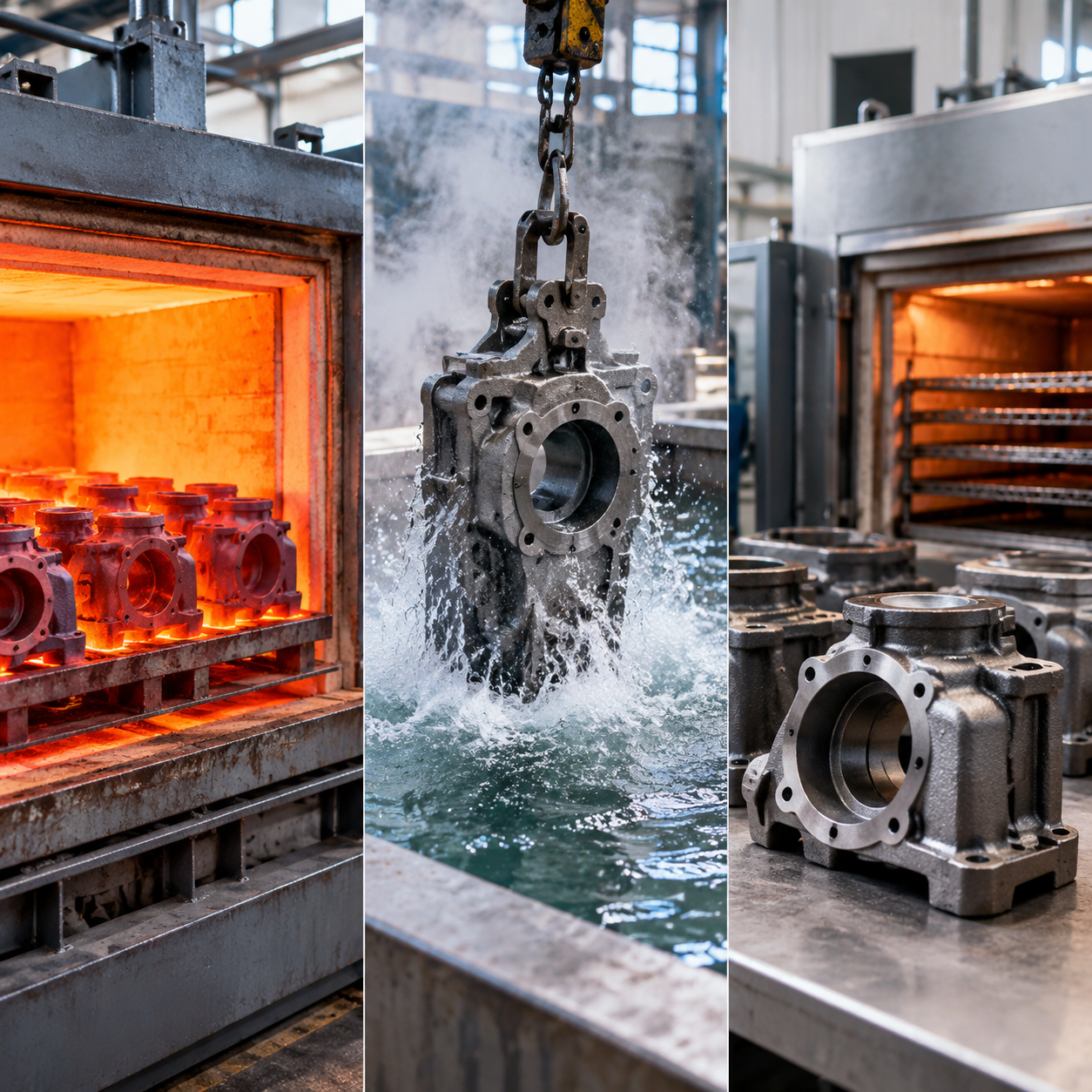
A practical guide for overseas B2B buyers on the effects of normalizing, quenching, and tempering on castings, including when heat treatment is worth the cost, expected hardness ranges, and distortion risks for thin-walled parts.
Normalizing: When and Why
Normalizing involves heating a casting to 30–50°C above its upper critical temperature, holding until the structure is uniform, then cooling in still air. This process refines the grain structure, improves machinability, and relieves internal stresses from casting. It is particularly beneficial for large or complex castings where residual stresses could cause warping during later machining.
Normalizing is often the first heat treatment after casting. It is cost-effective because it does not require quenching tanks or tempering furnaces. For many gray iron and ductile iron castings, normalizing alone provides sufficient strength and uniformity. Typical hardness after normalizing for cast irons ranges from 150 to 250 HB, depending on alloy and section size.
Quenching: High Hardness, High Risk
Quenching rapidly cools a casting from austenitizing temperature (typically 800–900°C) in water, oil, or polymer. This creates a hard, wear-resistant martensitic structure. Hardness can reach 50–60 HRC (approximately 500–600 HB) for steels, but the trade-off is increased brittleness and a high risk of cracking or distortion.
Quenching is rarely the final step for castings. It is usually followed by tempering to reduce internal stresses and restore some toughness. For thin-walled castings (wall thickness <10 mm), quenching is particularly risky because uneven cooling causes severe distortion or cracking. In such cases, alternative processes like austempering or marquenching may be considered, though they add cost.
Tempering: Balancing Hardness and Toughness
Tempering reheats a quenched casting to a temperature below the lower critical point (typically 150–650°C) and holds it to allow controlled precipitation of carbides. This reduces hardness and relieves stresses, improving toughness and ductility. The exact tempering temperature depends on the desired final properties.
For many castings, tempering is essential after quenching. It transforms brittle martensite into tempered martensite, which offers a good combination of strength and impact resistance. Tempering also reduces the risk of delayed cracking. A typical tempering cycle for a quenched and tempered steel casting might be 2 hours at 400–600°C, resulting in hardness of 30–45 HRC (approximately 300–450 HB).
When Heat Treatment Is Worth the Cost
Heat treatment adds cost and lead time, so it should only be specified when the service conditions demand it. For low-stress applications, as-cast properties may suffice. However, for parts subject to wear, fatigue, or impact, heat treatment can extend service life significantly.
Consider heat treatment when: the casting must meet specific mechanical properties (e.g., tensile strength >700 MPa), the part will be machined extensively and requires stress relief, or the application involves abrasive wear. For thin-walled castings, weigh the benefits against distortion risk. In some cases, redesigning the part or choosing a different alloy may be more cost-effective than heat treatment.
- Is the casting subject to high wear or impact?
- Are there tight dimensional tolerances that require stress relief?
- Does the alloy respond well to heat treatment? (e.g., carbon steel vs. gray iron)
- Can the part be redesigned to avoid thin walls that distort?
- Is the added cost justified by improved performance or lifespan?
Frequently Asked Questions
What is the difference between normalizing and annealing?
Normalizing cools in air, producing a finer pearlite structure and higher strength than annealing, which cools slowly in the furnace. Annealing gives maximum softness and ductility, while normalizing offers a better balance of strength and machinability.
Can all castings be quenched and tempered?
No. Quenching and tempering is effective only for alloys that form martensite upon rapid cooling, such as many steels and some irons. Gray cast iron, for example, does not respond well to quenching due to its graphite flakes. Always consult the alloy specification.
How can I minimize distortion in thin-walled castings during heat treatment?
Use slower cooling media (e.g., polymer instead of water), support the part uniformly during heating and cooling, and consider stress-relief annealing before quenching. In some cases, a redesign to increase wall thickness or add ribs can reduce risk.
Looking for a reliable casting supplier? Request a quote from Intercontinental Casting — our engineering team replies within one business day.