
Resin Sand vs Shell Molding for Mid-Volume Orders: Surface Finish, Tooling Lead Time, and Cost Crossover
Publication Date : 2026-10-13 16:25:22
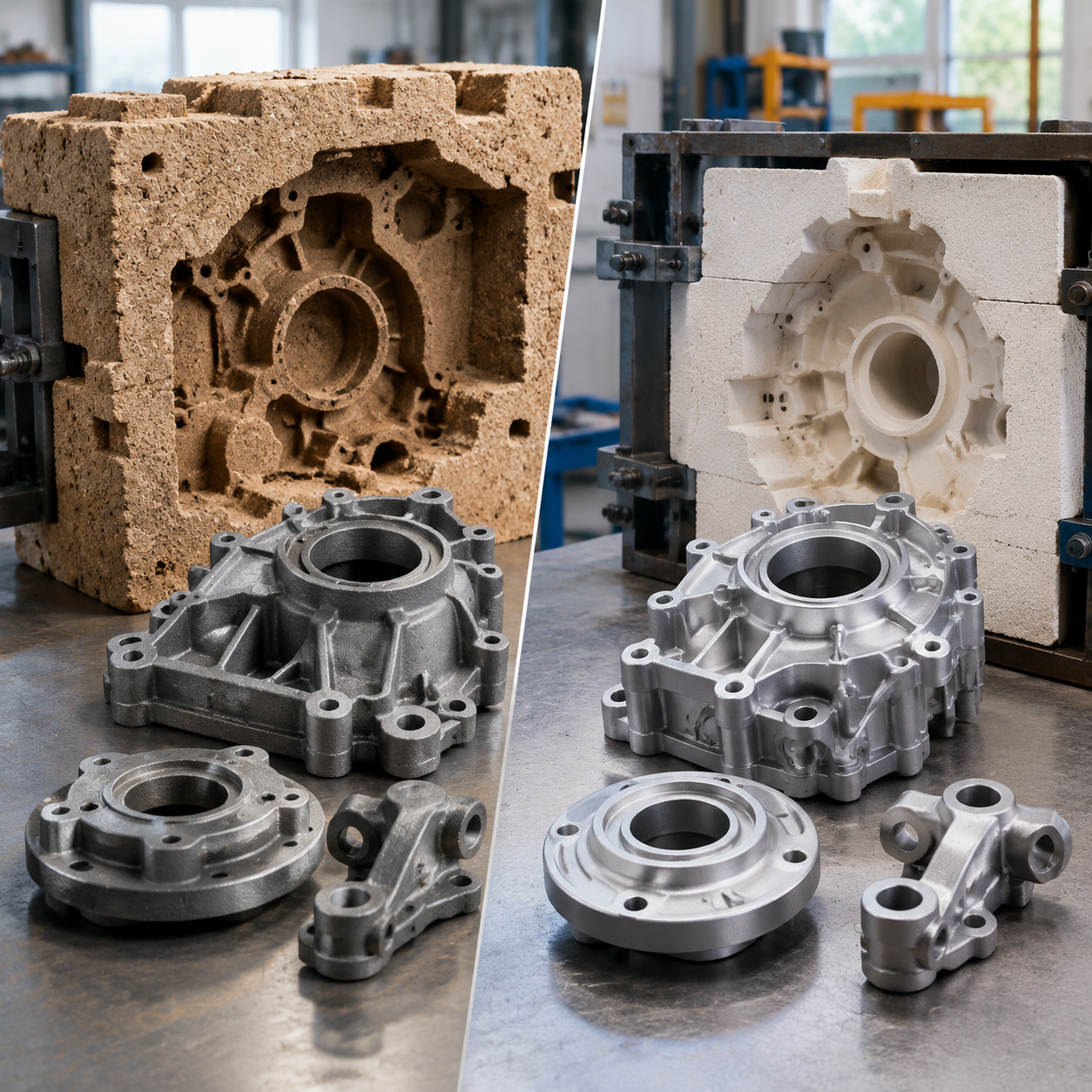
Comparing resin sand and shell molding for mid-volume casting orders (500–5,000 pieces). Learn how surface finish, tooling lead time, and per-piece cost crossover volumes affect your sourcing decision.
Surface Finish: What to Expect from Each Process
Resin sand casting typically delivers a surface roughness of Ra 12.5–25 µm (RMS 500–1000 µin). This is adequate for many industrial parts, but visible tool marks and minor sand inclusions may require additional finishing. Shell molding, using a pre-coated sand shell, achieves Ra 3.2–6.3 µm (RMS 125–250 µin), often eliminating the need for secondary machining on non-critical surfaces.
For mid-volume orders (500–5,000 pieces), the surface finish difference directly impacts labor costs. If your part requires a smooth finish, shell molding can reduce or eliminate grinding and polishing operations. However, if the part is painted or coated, resin sand may suffice, saving on tooling and per-piece costs.
Tooling Lead Time and Cost: Patterns and Dies
Resin sand casting uses a pattern (often wood or aluminum) that is relatively quick to produce. Lead time for a simple pattern is 2–3 weeks; complex patterns with cores may take 4–6 weeks. Pattern cost ranges from $500 to $3,000 depending on size and complexity. Shell molding requires a metal pattern (usually aluminum or iron) that can withstand higher temperatures. Lead time is typically 4–8 weeks, and pattern cost is higher: $1,500–$6,000.
For mid-volume orders, tooling lead time affects your time-to-market. If you need parts quickly, resin sand offers a faster start. But if you plan multiple orders over a year, the durability of shell molding patterns (often lasting 100,000+ cycles) may justify the higher upfront investment.
- Resin sand pattern: 2–6 weeks lead time, $500–$3,000 cost
- Shell molding pattern: 4–8 weeks lead time, $1,500–$6,000 cost
- Consider pattern material: wood for prototypes, aluminum for production
- Shell patterns last longer but require more machining time
Per-Piece Cost Crossover: When Does Shell Molding Become Cheaper?
Per-piece cost in resin sand is lower for small quantities because tooling is cheaper and the process is less labor-intensive. However, shell molding can become more economical at higher volumes due to reduced finishing costs and better dimensional consistency. The crossover volume depends on part complexity, required tolerances, and finishing needs. For a typical part with moderate finishing requirements, the crossover is around 2,000–3,000 pieces.
For parts with tight tolerances or complex cores, the crossover may be lower (1,000–1,500 pieces) because shell molding reduces machining and scrap. Conversely, for simple parts with loose tolerances, resin sand remains cost-effective even at 5,000 pieces.
Decision Checklist for Mid-Volume Sourcing
Use this checklist to choose between resin sand and shell molding for your next mid-volume order. Start by defining your surface finish and tolerance requirements. If Ra < 6.3 µm is needed, shell molding is likely necessary. Next, estimate your annual volume: if you expect repeat orders totaling over 3,000 pieces, shell molding's higher tooling cost may be amortized. Finally, consider your timeline: if you need parts in under 6 weeks, resin sand is often the only viable option.
Always request quotes for both processes at your target volume. A good foundry will provide a breakdown of tooling, per-piece, and finishing costs. Remember that shell molding can reduce machining costs by 20–40% for complex parts, which can shift the crossover point.
Frequently Asked Questions
What is the typical minimum order quantity for shell molding?
Most foundries require a minimum of 500–1,000 pieces for shell molding to justify the higher tooling cost. For orders below 500, resin sand is usually more economical.
Can I use the same pattern for both resin sand and shell molding?
No, shell molding requires a metal pattern that can withstand higher temperatures, while resin sand can use wood or aluminum patterns. The patterns are not interchangeable.
How does the cost crossover volume change for complex parts?
For complex parts with tight tolerances or extensive machining, the crossover can drop to 1,000–1,500 pieces because shell molding reduces finishing costs and scrap rates.
Looking for a reliable casting supplier? Request a quote from Intercontinental Casting — our engineering team replies within one business day.