
Centrifugal Casting for Bushings: Why Density Matters
Publication Date : 2026-10-14 03:10:35
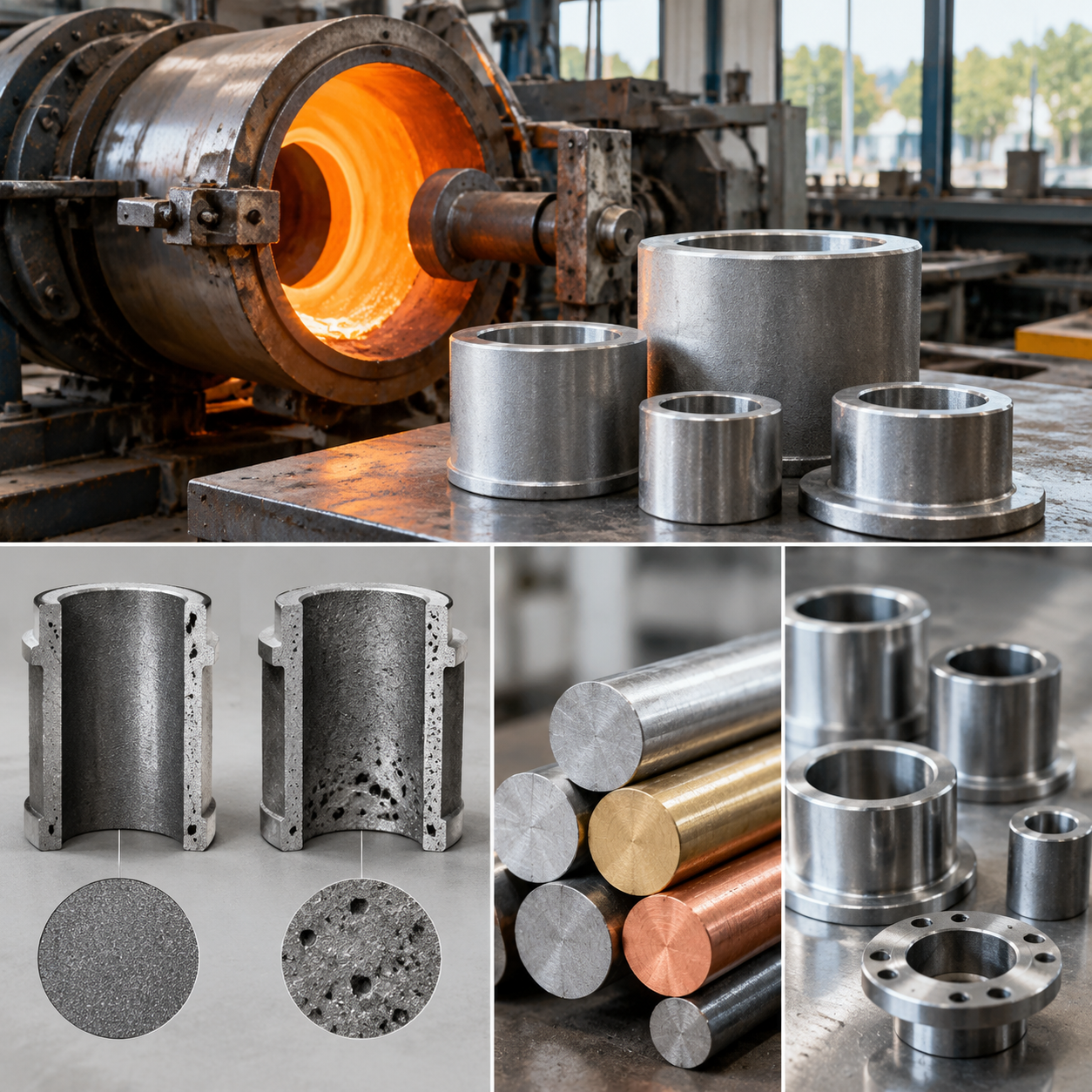
Centrifugal casting produces bushings with superior density and mechanical properties compared to static casting. This article explains the structural differences, typical alloys used, and when the higher cost of centrifugal casting is justified for B2B buyers.
Structure: Centrifugal vs. Static Casting
In static casting, molten metal is poured into a stationary mold and solidifies under gravity. This often results in shrinkage porosity, gas entrapment, and non-uniform grain structure, especially in thick sections. Centrifugal casting, by contrast, involves pouring metal into a rotating mold. Centrifugal force (typically 50–150 G) pushes the metal against the mold wall, creating a dense, directionally solidified structure with fewer defects. The rotation also helps separate lighter impurities and gases toward the inner bore, which can be machined away.
The result is a bushing with a fine, equiaxed grain structure on the outer diameter and a more uniform hardness profile. Static cast bushings often require additional processes like HIP (hot isostatic pressing) to achieve similar density, adding cost and lead time. For many bushing applications, centrifugal casting delivers the required density as-cast.
Typical Alloys for Centrifugal Cast Bushings
Centrifugal casting is compatible with a wide range of alloys. Common choices include tin bronze (e.g., C93200, C93700), aluminum bronze (C95400, C95500), and manganese bronze (C86300). For high-load applications, nickel-aluminum bronze (C95800) or even Monel are used. The rotation speed must be adjusted based on alloy density and freezing range; too slow and the metal won't distribute evenly, too fast and segregation can occur.
For bushings, the most popular alloy is C93200 (SAE 660) due to its good machinability and load capacity. Centrifugal casting of C93200 typically yields a tensile strength of 240–310 MPa, compared to 200–250 MPa for static castings. Hardness is also more consistent, often within ±5 HB across the length.
- Tin bronze C93200: general-purpose bushings, good machinability
- Aluminum bronze C95400: high strength, corrosion resistance
- Manganese bronze C86300: high load, wear resistance
- Nickel-aluminum bronze C95800: marine and high-temperature applications
When Centrifugal Casting Is Worth It
Centrifugal casting is not always the most cost-effective choice. For small bushings (OD < 50 mm) or low-volume orders, static casting or even machining from bar stock may be cheaper. However, when bushings exceed 100 mm in OD, have a length-to-diameter ratio greater than 1.5, or require pressure tightness (e.g., hydraulic cylinders), centrifugal casting becomes advantageous. The density improvement reduces the risk of leaks and extends service life.
Another factor is wall thickness. Centrifugal casting excels at wall thicknesses from 10 mm to 100 mm. Below 10 mm, the chill effect can cause premature solidification; above 100 mm, the density benefit diminishes unless rotation speed is carefully optimized. For bushings requiring a machined bore, the inner surface of a centrifugal casting often has a slight taper or impurities that are easily removed with 2–3 mm of machining allowance.
Frequently Asked Questions
What is the minimum order quantity for centrifugal cast bushings?
Most foundries require a minimum of 50–100 pieces per alloy and size to justify the setup. For larger bushings (OD > 200 mm), MOQ can be as low as 10–20 pieces.
Can centrifugal casting achieve the same tolerances as static casting?
Centrifugal castings typically have better dimensional consistency due to the rigid mold, but machining is still required for critical dimensions. As-cast tolerances are around ±1.5 mm for OD and ±2 mm for length, which is comparable to static casting.
How does the cost of centrifugal casting compare to static casting?
Centrifugal casting usually costs 20–40% more than static casting for the same part, due to higher equipment and labor costs. However, the improved density can reduce scrap and extend service life, often offsetting the initial premium.
Looking for a reliable casting supplier? Request a quote from Intercontinental Casting — our engineering team replies within one business day.