
Pump Impellers: Cast vs Fabricated — A Buyer's Comparison
Publication Date : 2026-10-17 03:10:44
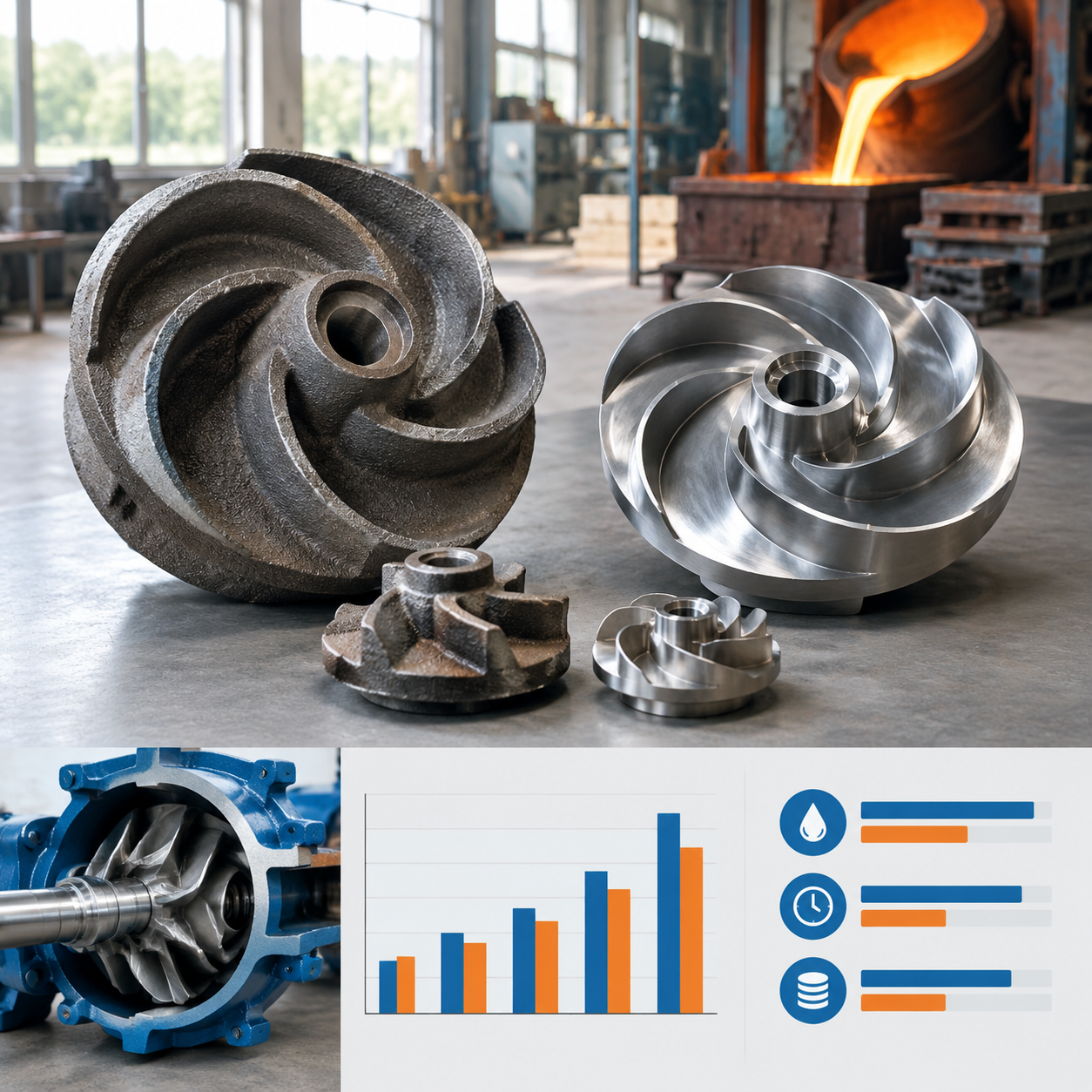
Compare cast and fabricated pump impellers on hydraulic efficiency, lead time, and volume economics. Includes practical ranges, checklists, and lead time bar chart to guide sourcing decisions.
Hydraulic Efficiency: Cast vs Fabricated
Hydraulic efficiency depends on impeller geometry, surface finish, and material integrity. Cast impellers, produced via sand or investment casting, can achieve complex vane shapes with smooth transitions. Typical efficiency for a well-made cast impeller ranges from 75% to 88% for water applications, depending on specific speed and size. Fabricated impellers, welded from plate and bar stock, often have sharper edges and rougher surfaces unless extensively ground. Their efficiency typically falls between 65% and 80%. For high-head, low-flow pumps, cast impellers hold an edge due to better flow control. For large, low-head pumps, fabricated impellers can be competitive if weld quality and finishing are controlled.
Buyers should request a hydraulic performance curve from the supplier. For cast impellers, ask about core shift tolerance (typically ±0.5 mm to ±1.5 mm) and surface roughness (Ra 3.2 to 12.5 µm as-cast). For fabricated impellers, specify weld prep, grinding to Ra 1.6 to 6.3 µm, and stress relief. Note that efficiency differences of 3–5 percentage points can translate to significant energy cost over years of operation.
Lead Time: What to Expect
Lead time is often the deciding factor for urgent projects. Cast impellers require pattern making, molding, pouring, cooling, and machining. For a new pattern, add 2–4 weeks. Existing pattern castings typically ship in 4–8 weeks for small to medium sizes, and 8–14 weeks for large or complex parts. Fabricated impellers skip pattern making; they are cut, formed, welded, and machined. Standard fabricated impellers can be ready in 2–5 weeks, and emergency orders in 1–2 weeks. However, if the design requires extensive machining or exotic alloys, fabricated lead times can extend to 6–8 weeks.
Shipping and finishing add time. Castings often need more machining allowance, adding 1–2 weeks. Fabricated parts may need stress relief and non-destructive testing, adding 3–7 days. Always confirm lead time from PO to delivery, not just production time.
Volume Economics: When to Choose Which
For low volumes (1–10 pieces), fabricated impellers are usually cheaper because there is no pattern cost. A simple fabricated impeller might cost $500–$2,000, while a cast equivalent with new pattern could be $3,000–$8,000 including pattern. At medium volumes (50–500 pieces), castings become economical: pattern cost is amortized, and unit price drops to $200–$800. Fabricated unit price remains relatively flat, around $400–$1,500, depending on complexity. At high volumes (1,000+ pieces), castings dominate, with unit prices often below $150 for small sizes.
Material matters. Casting allows alloys like duplex stainless steel and high-chrome iron that are difficult to weld. Fabrication is limited to weldable grades like carbon steel, 304/316 stainless, and some duplex grades with careful procedure. If your pump handles abrasive slurries, cast high-chrome impellers last longer despite higher initial cost. For corrosive but clean fluids, fabricated stainless may be sufficient and cheaper.
- Volume 1–10: Fabricated (no pattern cost)
- Volume 10–50: Compare total cost; fabricated often wins
- Volume 50–500: Casting becomes competitive; request quotes both ways
- Volume 500+: Casting typically lowest unit cost
- Abrasive service: Cast high-chrome or ceramic-reinforced
- Corrosive service: Cast duplex or fabricated 316L
- Emergency repair: Fabricated for speed
- OEM long-term: Cast for repeatability and efficiency
Quality and Inspection Checklist for Buyers
Whether cast or fabricated, inspection is critical. For castings, check for porosity, blowholes, and sand inclusion. Require radiographic or dye penetrant testing on critical sections. Verify chemical composition and mechanical properties with a mill certificate. For fabricated impellers, inspect weld quality (undercut, porosity, penetration), dimensional accuracy, and balance. Dynamic balancing is essential for both types; specify ISO 1940 balance grade G6.3 or better.
Always request a first article inspection report (FAIR) with dimensional results. For castings, include a pattern layout inspection. For fabricated, include weld maps and NDT reports. Finally, confirm that the impeller is dynamically balanced and that the supplier provides a certificate of conformance.
Frequently Asked Questions
Can a fabricated impeller match the efficiency of a cast impeller?
In some cases, yes—if the fabricated impeller is designed with smooth, continuous vanes and carefully ground and polished. However, for complex 3D vane shapes, cast impellers generally achieve 3–8% higher efficiency. For large, low-head pumps, a well-made fabricated impeller can come within 2–3% of cast performance.
What is the typical minimum order quantity for cast impellers?
Many foundries accept orders as low as 1–5 pieces, but pattern costs make small orders expensive. For economic production, a minimum of 20–50 pieces is common. Some suppliers waive pattern costs if you commit to a certain annual volume.
How do I choose between cast and fabricated for a corrosive application?
First, identify the fluid and temperature. For chlorides or acids, cast duplex stainless steel (e.g., 2205) or high-silicon iron may be best. If the fluid is mildly corrosive and you need quick delivery, fabricated 316L stainless can work. Always verify material compatibility and consider corrosion allowance.
Looking for a reliable casting supplier? Request a quote from Intercontinental Casting — our engineering team replies within one business day.