
Shrinkage Allowance Rules for Gray and Ductile Iron Castings
Publication Date : 2026-10-26 03:10:37
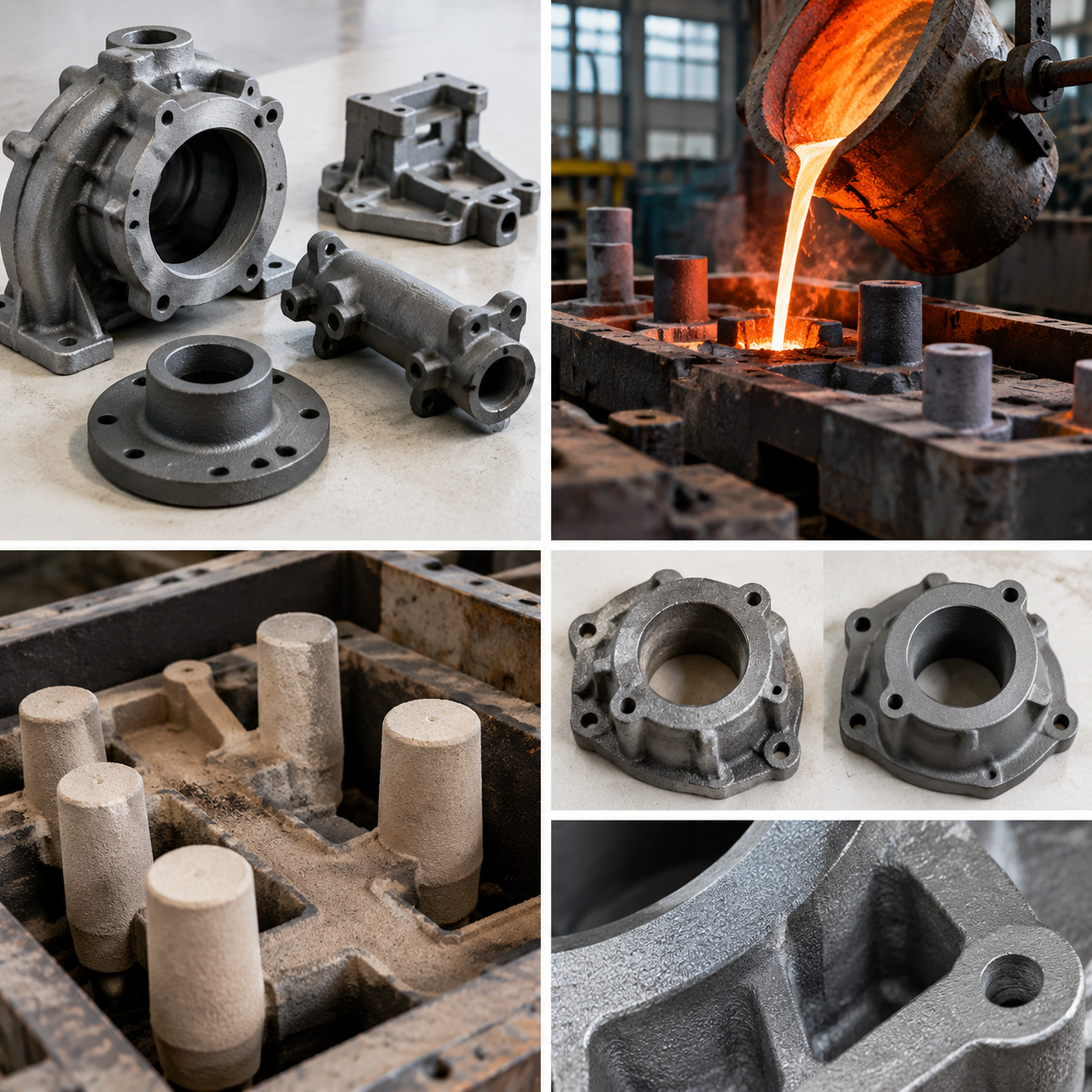
Practical shrinkage allowance ranges for gray and ductile iron, how riser placement interacts with contraction, and why pattern marks and shrink rules differ from foundry to foundry.
Typical Shrink Rates for Gray and Ductile Iron
Shrinkage allowance is the dimensional compensation cut into the pattern so the solid casting lands on nominal size after cooling. For gray iron (flake graphite), most foundries work with a linear contraction of roughly 0.8–1.0% (about 8–10 mm per metre), while ductile iron (spheroidal graphite) runs higher, typically 0.9–1.3% (9–13 mm per metre). The spread is real: thin, restrained sections contract less than heavy, free sections, and graphite expansion during solidification offsets some of the liquid and solid contraction in both irons.
A workable starting rule is 1.0% for gray iron and 1.1–1.2% for ductile iron on general machinery castings, then adjust by section. Heavy sections above roughly 50 mm often need the upper end of the range; thin walls under 10 mm can sit at the lower end because the mould restrains contraction. For dimensionally critical features—bore centres, bolt patterns, machined faces—agree the shrink figure with the foundry in writing before pattern release, because the pattern is where the allowance is locked in.
Riser Placement Basics and How They Interact with Contraction
Risers feed liquid and solidification shrinkage, not pattern shrinkage, but the two are linked: a riser that keeps a heavy section liquid longer also lets that section contract more freely, so the pattern allowance there should lean to the high side. Place risers so they feed the heaviest section last to freeze, keep feeding paths short (a riser neck should stay solid while the casting section is still liquid), and avoid putting a riser where it creates a hot spot in a thin wall. For ductile iron, graphite expansion during eutectic solidification reduces feed metal demand, so risers can often be smaller than on an equivalent gray iron casting—but only if the mould is stiff enough to convert that expansion into pressure rather than wall movement.
Use this checklist when reviewing a rigging layout:
Riser on the heaviest section, sized so it freezes after that section. Short, thick necks that stay open until the casting section freezes. No riser feeding through a thin wall. Chills or pads where a hot spot cannot be fed. Mould and core strength checked for ductile iron expansion. Pattern shrink direction confirmed against the riser layout, not separately.
- Riser on the heaviest section, sized so it freezes after that section.
- Short, thick necks that stay open until the casting section freezes.
- No riser feeding through a thin wall.
- Chills or pads where a hot spot cannot be fed.
- Mould and core strength checked for ductile iron expansion.
- Pattern shrink direction confirmed against the riser layout, not separately.
Why Pattern Marks Differ Between Foundries
Two foundries can quote the same drawing and cut different shrink rules, and both can be right. Pattern marks—the shrink rule, the marked shrink allowance on the pattern, and the layout of matchplate features—reflect each foundry's moulding method, sand system, pouring temperature, and gating practice. A foundry running green sand with high mould hardness may need less ductile iron shrink compensation than one running a softer, more yielding mould, because a stiff mould resists expansion and pushes contraction into the casting. Pouring temperature shifts contraction too: hotter metal means more liquid contraction and often a higher effective shrink.
Pattern marks also carry the foundry's own history. If a shop has run a family of pump housings for years at 1.0% and its machining allowances absorb the difference, it will keep that rule rather than re-cut patterns for a 0.1% change. That is why a buyer moving a pattern between foundries should ask for the shrink rule, the machining allowance, and the pattern drawing, and should expect the new foundry to re-mark the pattern rather than copy the old marks. Treat pattern marks as foundry-specific process data, not a universal standard.
A Buyer's Checklist for Shrink and Pattern Approval
Before approving a pattern, confirm four numbers in writing: the shrink rule used (for example 1.0% gray iron, 1.15% ductile iron), the machining allowance per surface, the draft angle, and the dimensional report from the first article. Check critical dimensions on the first casting against the drawing, not against the pattern, and check them again after machining. If a dimension is consistently off in the same direction, the fix is usually the shrink rule or the pattern mark, not the machining program.
Also agree who owns pattern storage and re-marking. If the pattern moves to another foundry, the new shop should re-mark it to its own shrink rule and record the change. Keep the approved shrink rule with the drawing revision so a future pattern repair does not quietly reset the allowance.
Frequently Asked Questions
What shrinkage allowance should I specify for a ductile iron casting?
Start at 1.1–1.2% linear for general ductile iron sections, moving toward 1.3% for heavy sections and 0.9% for thin, restrained walls. Confirm the final figure with the foundry against their moulding method and gating, and lock it in writing before the pattern is cut.
Why does a new foundry want to re-mark my existing pattern?
Pattern marks encode that foundry's shrink rule, machining allowance, and moulding behaviour. A different sand system, mould hardness, or pouring temperature changes effective contraction, so the new foundry re-marks the pattern rather than copying marks that were tuned to another shop's process.
Do risers change the shrinkage allowance on the pattern?
Not directly—risers feed solidification shrinkage, while the pattern allowance compensates cooling contraction. But riser placement changes how freely a section contracts: a riser keeping a heavy section liquid longer usually means that section needs the higher end of the shrink range.
Looking for a reliable casting supplier? Request a quote from Intercontinental Casting — our engineering team replies within one business day.