
What Actually Drives Casting Cost? A Cost-Driver Breakdown
Publication Date : 2026-10-29 03:10:58
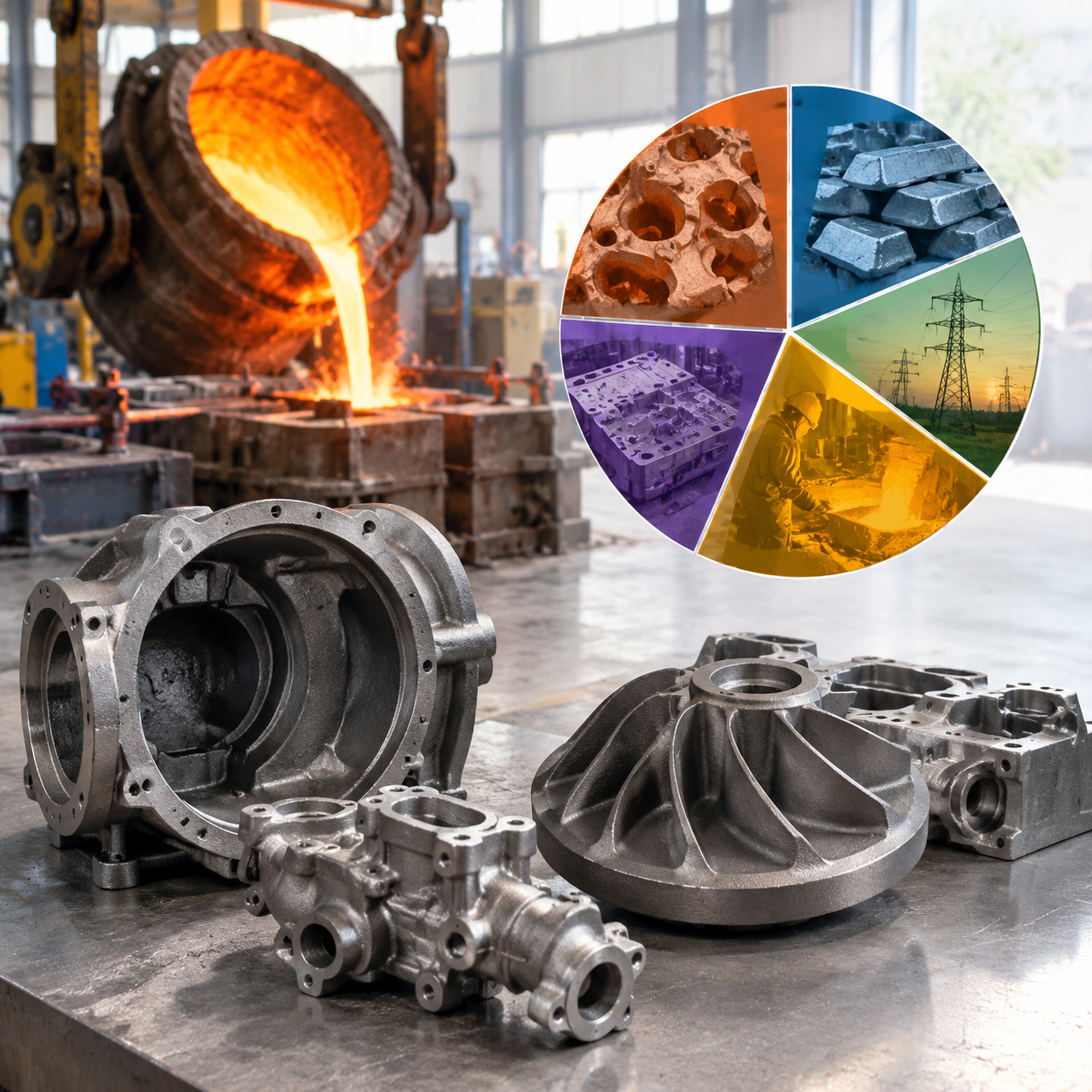
A practical breakdown of the five factors that move a casting quotation most — metal, energy, labor, tooling and yield — with typical cost splits, ranges and a checklist buyers can use to challenge or validate a quote.
Metal Is the Biggest Line Item — and the One You Can Control Most
In most ferrous and non-ferrous castings, metal accounts for roughly 40–60% of the piece price. The driver is not just the alloy price on an exchange; it is the charged weight versus the finished weight. If a 10 kg finished part requires a 13 kg pouring weight, you pay for 3 kg of gates, risers and scrap. Ask for the pouring weight, the yield percentage and the return-scrap credit in writing. A supplier that quotes only finished weight is either hiding the yield or hasn't calculated it.
Alloy choice moves cost faster than most buyers expect. Switching from a standard grey iron to a ductile grade, or from ADC12 to a low-iron aluminum alloy, can add 10–25% to the metal line before any process change. Specify the minimum mechanical properties and the application environment, not a brand-name alloy, and let the foundry propose the cheapest grade that passes. Also confirm whether scrap credit is settled at the purchase price or at a discounted rate — on a 3 kg excess weight at 2 USD/kg, that difference is real money per part.
Energy and Labor: The Two Lines That Vary Most by Region and Process
Melting is energy-intensive. For induction melting of iron, typical electricity consumption runs about 500–600 kWh per tonne of liquid metal with good practice, and poorly utilized furnaces can push that 20–30% higher. In China, industrial electricity commonly sits in the 0.08–0.12 USD/kWh range depending on province and time-of-use tariffs, so energy lands around 5–10% of piece cost for medium castings — but for heat-treat and stress-relief steps it climbs. Ask whether the quote assumes a specific melting schedule; small batches melted once a week carry a different energy profile than continuous runs.
Labor in Chinese foundries typically accounts for 10–20% of piece cost, and it is concentrated in finishing — grinding, fettling, inspection and packing — rather than in molding. High-volume automated molding lines dilute labor; low-volume jobbing work does not. This is why the same part quoted at 500 pieces and at 5,000 pieces can differ by 25–40% per unit. If your volume is uncertain, ask for a price break table at 100, 500, 1,000 and 5,000 pieces so you can see how fixed costs are being absorbed. The chart below shows a typical cost split for a mid-volume, 5–15 kg ductile iron casting; treat it as a starting point for the conversation, not a universal rule.
Tooling and Yield: Where Buyers Lose Money Without Noticing
Tooling is a one-time cost that gets amortized into the piece price or billed separately, and both models are legitimate — but you need to know which one you're buying. A simple aluminum pattern for sand casting might run 1,000–5,000 USD; a steel die for high-pressure aluminum die casting of a medium part commonly runs 30,000–100,000 USD or more depending on slides and cavities. If tooling is amortized, ask over what quantity and what happens if you order less. If it is billed upfront, confirm ownership and the conditions for transferring it to another supplier.
Yield is the quiet cost driver. First-pass yield in sand casting typically sits in the 90–97% range for mature parts, while die casting with tight porosity requirements can be lower. Every point of scrap is re-melted energy and labor you still pay for. Ask for the quoted scrap allowance — often 3–8% — and whether it is built into the piece price or billed as a separate charge. The bar chart compares the relative weight of these drivers on a per-part basis for the same casting at two volumes.
A Buyer's Checklist for Reading a Casting Quote
Most quote disputes trace back to missing information rather than dishonesty. Before you compare two suppliers, make sure both quotes are built on the same basis: same pouring weight, same scrap allowance, same tooling treatment, same Incoterm and same inspection standard. A quote that is 15% cheaper often just has a different assumption buried in it.
Use this checklist when a quote arrives, and ask the supplier to confirm each point in writing:
- Pouring weight vs finished weight, and the stated yield percentage
- Alloy grade with minimum mechanical properties, plus scrap credit terms
- Electricity assumption or melting schedule if volume is low
- Tooling: upfront or amortized, over what quantity, and who owns it
- Quoted scrap allowance (typically 3–8%) and how rejects are handled
- Price breaks at 100 / 500 / 1,000 / 5,000 pieces
- Machining and surface treatment: in-house or subcontracted, and at what markup
- Incoterm, packaging cost and inspection standard (e.g., visual only vs dimensional report)
Frequently Asked Questions
Why is the same casting quoted 30% cheaper by another supplier?
Usually a different basis, not a different cost. Common culprits: a lower pouring weight assumption, no scrap allowance, tooling amortized over a much larger quantity, thinner wall sections that raise yield risk, or a lower inspection standard. Ask both suppliers to restate the quote against the same checklist before you compare numbers.
How much should I expect tooling to cost for a medium-sized casting?
For sand casting, a simple pattern and core box typically runs 1,000–5,000 USD. For aluminum high-pressure die casting of a medium part, a steel die commonly runs 30,000–100,000 USD or more depending on cavities and slides. Always clarify whether tooling is billed upfront or amortized into the piece price, and confirm ownership.
Does order volume really change the piece price that much?
Yes. Labor and tooling amortization are the swing factors. Going from 500 to 5,000 pieces can reduce per-unit cost by 25–40% because fixed setup and finishing labor are spread over more parts. Ask for a price break table so you can see where the curve flattens before you commit to a volume.
Looking for a reliable casting supplier? Request a quote from Intercontinental Casting — our engineering team replies within one business day.