
Casting vs Fabrication: True Cost at Different Volumes
Publication Date : 2026-11-01 03:10:36
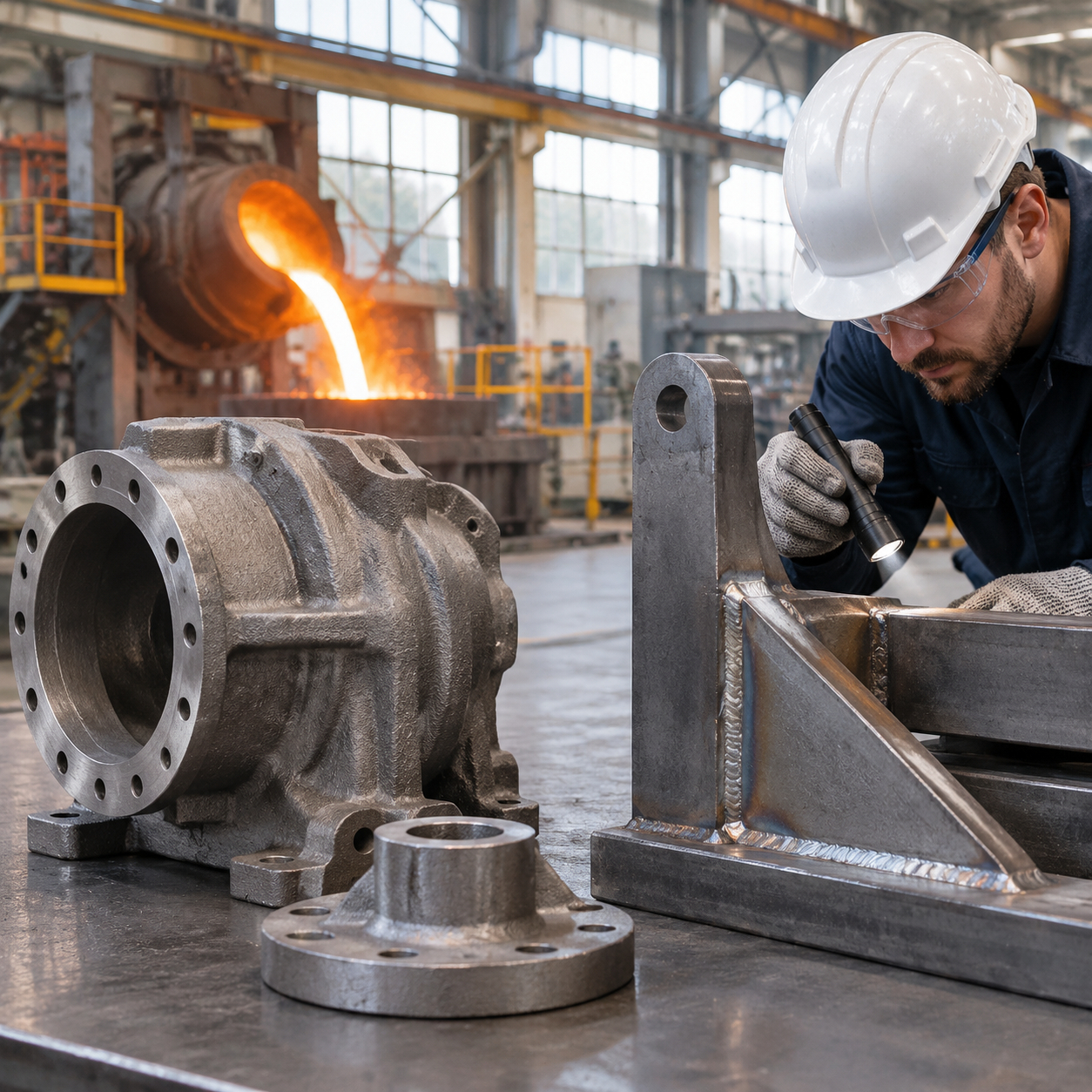
A volume-by-volume comparison of castings and weldments, including the crossover point where tooling amortization flips the decision, the hidden weld inspection burden on fabrications, and a practical checklist for quoting both routes.
Why the Unit Price You See Is Not the Cost You Pay
Almost every sourcing decision between casting and fabrication starts with a per-piece quote, and almost every per-piece quote misleads at low and mid volumes. A fabrication quote typically covers material, cutting, fit-up, welding, and a basic visual inspection — it carries no tooling, so it looks cheap at quantity 1 and stays roughly linear as volume rises. A casting quote bundles a pattern or die cost into the first order, so the per-piece number at quantity 50 can look 40–80% higher than the weldment, while at quantity 5,000 it can land 20–40% below it. The comparison is only meaningful when you compare total landed cost at your actual annual volume, not the quote sheet's unit price.
The second distortion is inspection. Buyers routinely compare a fabrication quote that includes visual inspection only against a casting quote that includes dimensional layout and a first-article report. That is not the same scope. For structural weldments, weld inspection — dimensional checks, weld size verification, and where specified, NDT such as dye penetrant or ultrasonic testing — is a real labor and schedule line item that often adds 8–20% to the fabrication cost at medium volumes and more on complex, multi-pass weldments. Ask both suppliers to quote to the same inspection standard before you compare anything.
The Crossover Volume: Where Castings Overtake Weldments
In practice, the crossover point for simple, non-critical parts — brackets, housings, covers, levers — usually falls between 300 and 1,500 pieces per year depending on part size, pattern cost, and machining allowance. Small parts with simple patterns and modest machining can cross over near the low end; large parts with complex cores, heat treatment, or tight tolerances tend to cross over above 1,000–2,000 pieces. Above the crossover, castings win on labor content: welding time per part stays roughly constant, while casting cycle time per part drops with volume.
Below the crossover, fabrication usually wins because you pay for tooling you may never amortize. A typical sand pattern and core box for a mid-size part might run USD 2,000–15,000 depending on complexity; a permanent mold or die can run far higher. If your program is 200 pieces and may be redesigned next year, that tooling is a sunk cost with no second order to absorb it. The chart below shows a representative total-cost comparison across volumes for a mid-size bracket; treat the shape of the curves as the lesson, not the exact numbers.
The crossover is not fixed. Design changes move it: adding draft and uniform wall thickness to a part designed for welding can cut casting tooling cost and defect rates, pulling the crossover down. Conversely, specifying tight flatness or thin walls that require extensive machining after casting can push it up.
The Weld Inspection Burden: The Cost Line Buyers Forget
Fabrication's hidden cost is not the welding itself — it is proving the weld is good. Every weldment carries a weld map: joint count, weld length, number of passes, and the inspection regime those joints trigger. A bracket with 12 short fillet welds may need only visual inspection and a dimensional check. A frame with 40 joints, mixed full-penetration and fillet welds, and a load-bearing duty may require dye penetrant on a percentage of joints, ultrasonic testing on critical ones, and documented welder qualifications. Each of those steps adds labor, calendar time, and paperwork — and rework rates on complex weldments are not trivial, so budget for repair and re-inspection.
Castings are not inspection-free, but the burden is front-loaded and different in kind: first-article dimensional layout, material certification, and periodic sampling rather than per-joint NDT. For a buyer comparing routes at 500–2,000 pieces per year, the honest comparison is fabrication cost plus weld inspection plus expected rework versus casting cost plus tooling amortization plus machining. The pie chart shows a typical fabrication cost breakdown at medium volume for a structural weldment; note how much of the total sits outside the welding arc itself.
Practical mitigation exists on both sides. On fabrications, reduce joint count, standardize weld sizes, and negotiate an inspection plan tied to service duty rather than a blanket NDT callout. On castings, specify machining allowance and datum strategy up front so post-cast inspection is a sampling exercise, not a per-part fight.
A Practical Checklist for Quoting Both Routes
Run both quotes against the same scope and the same annual volume, and force the suppliers to expose the lines that usually hide. The checklist below is the minimum set of questions that turns two incomparable quotes into a real decision. If a supplier cannot answer a line, that is itself information about the risk you are taking on.
One more discipline: model the decision over the program life, not the first order. If the part will run three years at 800 pieces per year, amortize tooling over the full 2,400 pieces and check whether a design-for-casting revision in year two would have paid for itself. Buyers who quote only the first order almost always choose fabrication and then pay more for three years.
- State annual volume and program life in the RFQ; ask for pricing at 100, 500, 2,000, and 10,000 pieces
- Require tooling cost as a separate, itemized line with ownership and buy-back terms
- Specify the inspection standard identically for both routes (dimensional, visual, NDT percentage)
- For fabrications, ask for joint count, total weld length, and the proposed inspection plan
- For castings, ask for pattern cost, machining allowance, expected scrap rate, and first-article lead time
- Ask both suppliers for rework/repair history on comparable parts, not just capability statements
- Include finishing, heat treatment, and freight in both totals before comparing
- Confirm who owns inspection documentation and how long it is retained
Frequently Asked Questions
These are the three questions that come up most often when buyers compare casting and fabrication quotes side by side.
FAQ
These are the three questions that come up most often when buyers compare casting and fabrication quotes side by side.
Frequently Asked Questions
At what volume does casting become cheaper than fabrication?
For simple, non-critical parts, the crossover typically falls between 300 and 1,500 pieces per year; larger or more complex parts often cross over above 1,000–2,000 pieces. The exact point depends on pattern cost, machining allowance, and the weld inspection regime the fabrication would require. Always compare total cost including tooling amortization and inspection at your actual annual volume.
How much does weld inspection really add to a fabrication?
On structural weldments at medium volume, inspection and NDT commonly add roughly 8–20% to the fabrication cost, plus rework and re-inspection. The driver is joint count and service duty: a part with a dozen short fillet welds may need only visual and dimensional checks, while a load-bearing frame with full-penetration joints can require percentage-based dye penetrant or ultrasonic testing and documented welder qualifications.
Can I avoid paying for casting tooling if volumes are uncertain?
Yes, in several ways: negotiate tooling ownership and buy-back terms so the pattern or die remains your asset, start with a lower-cost process such as sand casting before committing to permanent mold, or ask for a design-for-casting review to simplify the pattern and reduce tooling cost. If the program may be redesigned within a year, fabrication usually remains the lower-risk route until volume is proven.
Looking for a reliable casting supplier? Request a quote from Intercontinental Casting — our engineering team replies within one business day.