
Small Batch vs Mass Production: The Real Casting Price Curve
Publication Date : 2026-11-05 03:10:36
Why does a 50-piece casting order cost three times the per-piece price of a 5,000-piece run? This article breaks a casting quote into fixed and variable costs, shows the actual shape of the price curve, and gives practical batch-sizing rules for buyers who need small runs without overpaying.
Where Your Casting Quote Actually Comes From
Every casting quotation is a stack of fixed and variable costs, and the two behave completely differently as quantity changes. Fixed costs are incurred once per order regardless of volume: pattern and core box fabrication (typically USD 800–4,000 for a medium-complexity aluminum part, more for large steel patterns), tooling amortization, first-article inspection, setup and line-change time at the foundry, and inbound freight of the tooling. Variable costs scale roughly linearly with pieces: metal, melting energy, molding labor, fettling and shot blasting, machining time if required, and per-piece inspection.
The consequence is simple arithmetic. If a part has USD 2,400 of fixed cost and USD 6 of variable cost per piece, a 100-piece order carries USD 24 of fixed cost per piece (total unit price around USD 30), while a 5,000-piece order spreads that same USD 2,400 over 5,000 units — just USD 0.48 per piece (unit price around USD 6.50). The metal does not get cheaper; the tooling does. Almost every 'small batch is expensive' conversation is really a conversation about how the fixed block is being allocated.
Reading the Price Curve: Where the Savings Live
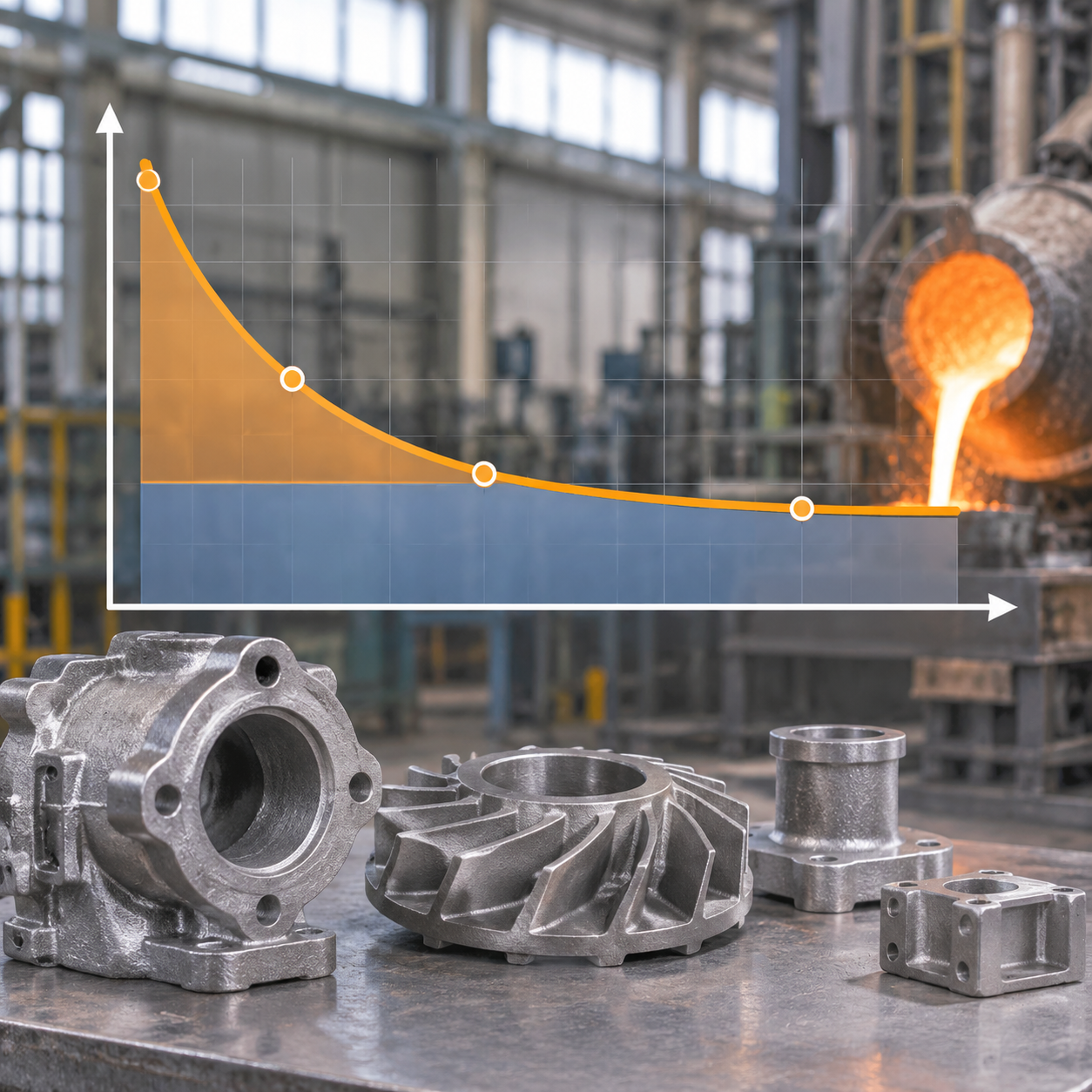
The casting price curve is not linear — it is a hyperbola. Most of the per-piece savings are captured in the first few hundred pieces, and the curve flattens hard after that. Going from 50 to 500 pieces typically cuts unit price by 70–80% on a tooled part. Going from 500 to 5,000 pieces might cut it by another 30–40%. Going from 5,000 to 50,000 often saves only 10–15%, because by then you are almost entirely on variable cost and the foundry's volume discounts on metal and melting are modest.
This has a practical implication for sourcing decisions: the jump from prototype quantities to a 'serious' small batch matters far more than the jump from a small batch to a large one. Buyers who negotiate hard on the 5,000-to-20,000 step while ordering 80 pieces are optimizing the wrong part of the curve. The chart below shows the same data as a share of total order cost, which makes the fixed block's dominance at low volumes obvious.
Batch-Sizing Rules That Actually Work
Start from your real annual demand, not from a round number. If you expect to sell 3,000 units a year, ordering 3,000 once is usually wrong — it ties up cash and warehouse space in castings that may be revised. Ordering 100 twelve times a year is also wrong, because you pay setup-heavy pricing every cycle and may pay for pattern maintenance repeatedly. A workable rule for most buyers is to size the first production batch at 3–6 months of demand, then reorder at 2–3 month intervals once the design is stable. For a part with USD 2,400 fixed cost and USD 6 variable cost, moving from 250 to 500 pieces drops unit price from about USD 15.60 to USD 10.80 — a 31% saving — which usually justifies holding a few extra months of stock.
Use these checkpoints before you commit to a quantity: (1) confirm whether the quoted tooling is dedicated or shared — shared pattern plates can cut fixed cost by 40–60% but limit your geometry freedom; (2) ask for a price break table at 100 / 250 / 500 / 1,000 / 2,500 pieces so you can see your own curve; (3) check whether the foundry has a minimum heat or melt size (often 300–500 kg) — below that, you may be paying for metal poured into other customers' orders or for a small furnace run; (4) separate machining from casting in the quote, since CNC setup is a second fixed block that behaves the same way.
A checklist for the small-batch buyer: get the fixed/variable split in writing; ask what portion of tooling is reusable if the design changes; confirm the minimum melt size and whether your quantity sits above or below it; request first-article inspection priced as a line item rather than buried in unit price; and ask for the reorder price separately from the first-order price, because the second order should not carry pattern cost again.
When Mass Production Is the Wrong Answer
Large batches only pay off when the design is frozen and demand is proven. If your part is likely to change — a mounting boss moves, a wall thickness changes, a machining datum shifts — a 10,000-piece order can turn a USD 2,400 pattern into scrap and leave you with thousands of unusable castings. In that situation the higher unit price of a 300–500 piece batch is cheap insurance. Many experienced buyers deliberately run two or three small batches through a design revision cycle before committing to volume.
There is also a floor below which small batches stop making economic sense. Below roughly 50–100 pieces for a sand-cast part, you are often paying for a full setup and a minimum melt with very few pieces to absorb it, and per-piece prices can exceed the tooling cost itself. At that point, consider alternative processes — investment casting with shared wax trees, or machining from billet — or accept that the prototype batch is a development cost, not a production price. The right question is never 'small or large?' but 'which batch size puts me on the flat part of my own curve without over-committing?'
- Get the fixed/variable cost split in writing before comparing suppliers
- Request price breaks at 100 / 250 / 500 / 1,000 / 2,500 pieces
- Size the first production batch at 3–6 months of demand
- Confirm minimum melt size (often 300–500 kg) and where your order sits relative to it
- Price first-article inspection as a separate line item
- Ask for the reorder price separately — pattern cost should not recur
- Delay mass production until the design has survived at least one revision
Frequently Asked Questions
Why is my 100-piece quote four times the per-piece price of a 1,000-piece quote?
Because the fixed cost block — pattern, core box, setup, first-article inspection — is divided by 100 instead of 1,000. On a part with USD 2,400 fixed cost, that alone adds USD 24 per piece at 100 units versus USD 2.40 at 1,000. The metal and labor portions of the quote are usually similar per piece; ask your supplier to show the split so you can verify this.
What is the smallest batch I can order without paying a penalty?
It depends on the process and the foundry's minimum melt size. For sand casting, orders below roughly 50–100 pieces often carry a full setup and minimum heat charge with few pieces to absorb it. Ask directly what the foundry's minimum melt is (commonly 300–500 kg) and whether your order falls below it, since that is where the real penalty starts.
Should I order a year of stock to get the lower unit price?
Usually not on a first production run. The steepest part of the savings curve is between a few hundred and about 1,000 pieces; beyond that, unit price flattens while your cash, storage, and design-revision risk keep growing. A first batch of 3–6 months of demand, followed by regular reorders at the tooling-free price, is typically the better balance.
Looking for a reliable casting supplier? Request a quote from Intercontinental Casting — our engineering team replies within one business day.