
Negotiating MOQ on Custom Castings: What Buyers Should Realistically Expect
Publication Date : 2026-11-09 03:10:47
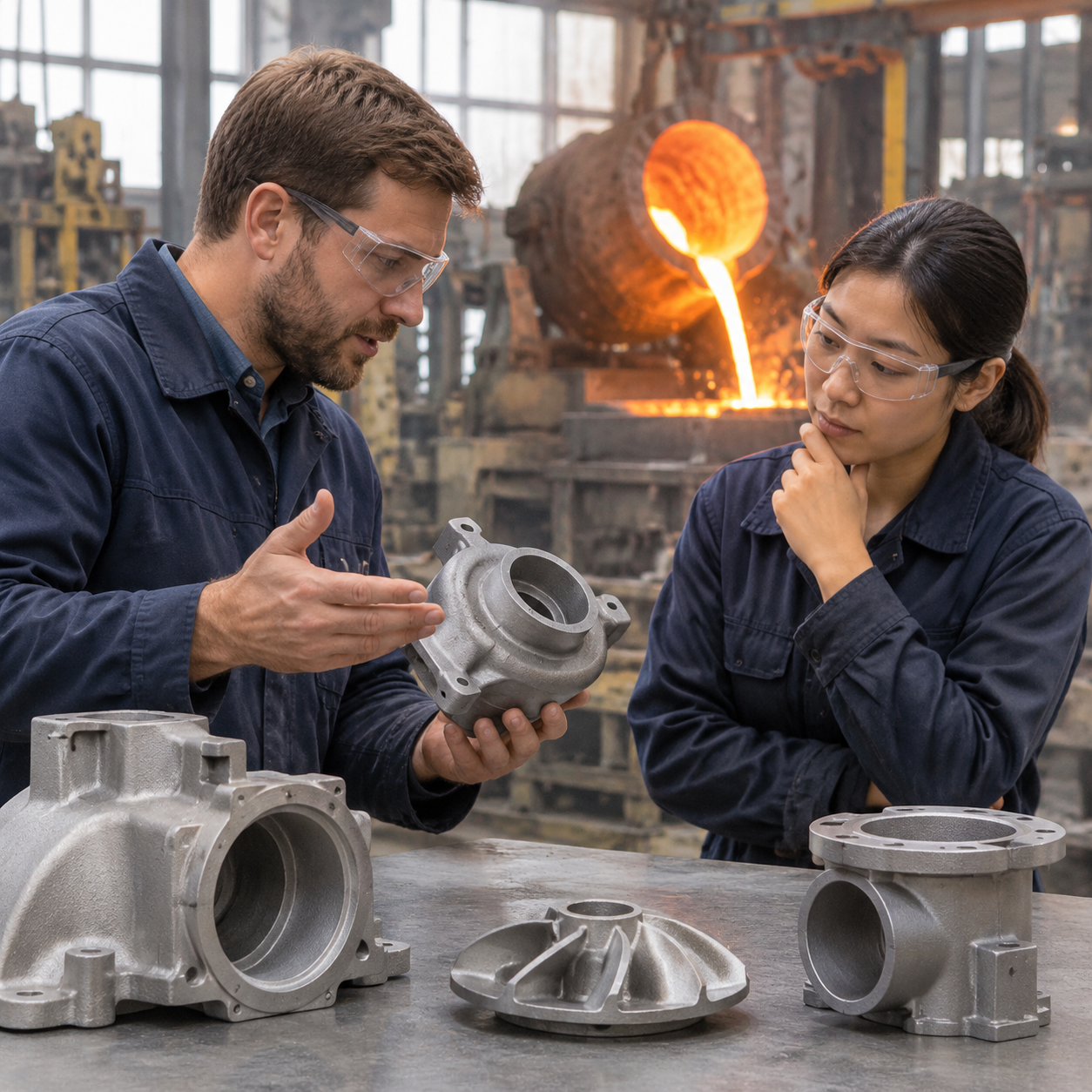
MOQ on custom castings is not arbitrary — it is driven by furnace heat size, tooling amortization, and alloy availability. This guide explains where minimums come from, gives realistic MOQ ranges by alloy and process, and shows buyers how to negotiate a workable first order without paying for metal they cannot use.
Why a Casting MOQ Exists: Heat Size and Tooling
Most casting MOQs trace back to two physical facts: a foundry melts metal in fixed-size batches (a "heat"), and every custom part needs tooling — a pattern, a die, or a wax injection mold — that only pays for itself across a certain volume. A small induction furnace might melt 500 kg per heat; a medium-frequency furnace serving a sand line commonly runs 1–3 tonnes per heat. If your order is 80 kg of stainless steel, the foundry still has to melt a full heat, tap it, and either pour your parts plus other jobs or waste the remainder. That is why quotes often come back as "minimum 300 kg" or "minimum one heat" rather than a piece count.
Tooling adds a second floor. A simple sand pattern for a part under 5 kg might cost USD 300–1,500; a permanent mold or low-pressure die for aluminum can run USD 3,000–15,000; a die-casting mold for a small aluminum housing often lands between USD 8,000 and 40,000. Foundries amortize that cost over expected annual volume, so a 200-piece order on a USD 20,000 die is commercially impossible unless the buyer pays the tooling separately or accepts a piece price that carries the full amortization. When a supplier quotes a high MOQ, ask directly: is this a heat constraint, a tooling constraint, or an alloy minimum from the mill? The answer determines what is negotiable.
Realistic MOQ Ranges by Alloy and Process
For sand casting and investment casting in carbon steel, low-alloy steel, and common stainless grades (304, 316, 2205), a realistic minimum for a custom part is one full heat — typically 300–1,000 kg — though many Chinese foundries will accept 100–300 kg for repeat customers or when the part can share a heat with similar alloy work. Small investment-cast parts (under 1 kg) are often quoted at 500–2,000 pieces because they are tree-mounted and a single pour covers many pieces. Ductile and gray iron sand castings usually start around 500 kg–1 tonne per pattern, since iron melts in large cupolas or medium furnaces.
Aluminum is more flexible: gravity and low-pressure permanent mold work often starts at 100–500 pieces, while high-pressure die casting typically needs 3,000–10,000 pieces to justify the mold. Copper alloys (bronze, brass) in sand or centrifugal casting commonly quote 200–500 kg. Specialty alloys — nickel-based superalloys, duplex stainless, cobalt alloys — carry the highest floors, often 500 kg–2 tonnes, because the mill sells in fixed ingot lots and scrap segregation is costly. The chart below shows typical first-order minimums buyers encounter for a mid-size custom part (roughly 1–5 kg) across common material families.
Where Negotiation Actually Works
The most effective lever is not arguing the number down but changing what is counted. Ask whether the MOQ applies per alloy heat or per part number: if the foundry is pouring 316 stainless for another customer, your 120 kg order can ride that heat, and many suppliers will accept it at a modest premium. Ask about sharing a pattern with a sister part, or about producing a "family" of two or three similar parts from one tool to reach the volume floor. If tooling is the blocker, request a tooling-paid-separately quote — you own the pattern or die, the piece price drops, and the MOQ often falls to the heat minimum.
Payment and scheduling terms also move MOQs. Offering a 12-month blanket order with quarterly releases at 250 kg each is far more attractive than a single 250 kg trial, and suppliers will often accept a smaller first shipment inside a committed annual volume. Be cautious with any offer to "hold" your metal for a future order — confirm in writing how long the heat balance is reserved and who bears the cost of remelting. A practical checklist for the first negotiation: confirm whether the MOQ is weight or pieces; ask for the heat size in kg; ask for tooling cost quoted separately and who owns the tool; request a price break table at 1x, 2x, and 5x MOQ; ask whether a shared heat is possible and at what premium; and get the trial-order terms — sample quantity, approval process, and lead time — in the quotation, not in a later email.
Structuring a First Order That Makes Sense
A workable first order usually combines a small trial with a committed follow-on. For a 2 kg stainless impeller with a 400 kg heat minimum, buyers commonly place a 100–150 kg trial (50–75 pieces) at a higher piece price, approve samples, then release the balance against a 12-month forecast. Expect the trial piece price to run 15–30% above the volume price; that premium covers setup, extra inspection, and the unabsorbed heat balance. If the foundry insists on the full heat, ask them to cast spare pieces from the same lot — the marginal cost of extra parts once the heat is poured is mostly metal and finishing, so a 400 kg order may yield 20–40% more pieces than you strictly need at a small increment.
Finally, budget for the costs that sit outside the piece price: pattern or die cost, first-article inspection, machining and surface treatment setup, and freight. A first order that looks 20% more expensive per piece than the target is normal; the goal of the negotiation is to reach a volume where the second and third orders hit the price you modeled. Put the agreed MOQ, price breaks, tooling ownership, and trial terms into the purchase agreement so the numbers survive staff changes on either side.
Frequently Asked Questions
Can I get a custom casting order below the quoted MOQ if I pay more per piece?
Often yes, especially when the constraint is a heat rather than tooling. Ask for a trial-order price at 25–50% of the quoted MOQ; expect a 15–30% piece-price premium to cover setup and the unabsorbed heat balance. Tooling-driven MOQs (die casting, permanent mold) are harder to reduce — there the usual path is paying for tooling separately and committing to an annual volume with scheduled releases.
Is the MOQ counted in pieces or kilograms?
It depends on the process and the foundry's costing method. Sand and investment castings in steel or iron are usually quoted in kilograms because the heat is a weight constraint; small investment-cast parts and die-cast aluminum are more often quoted in pieces. Always confirm the unit in writing, and ask for the heat size in kg so you can judge whether a smaller order is physically feasible.
Who owns the tooling, and can I move it to another foundry later?
This must be stated in the contract. Many Chinese foundries will acknowledge buyer ownership of a paid-for pattern or die, but transfer requires settling any outstanding tooling balance and arranging export packing and shipping, which you pay for. Request a written tooling ownership clause, a tool condition report at the end of each production year, and confirmation that the tool will be maintained and stored at the foundry's cost while you are an active customer.
Looking for a reliable casting supplier? Request a quote from Intercontinental Casting — our engineering team replies within one business day.