
CF8 vs CF3M: Stainless Casting Grades Decoded for Buyers
Publication Date : 2026-11-15 03:10:33
CF8 and CF3M are the two workhorse austenitic stainless casting grades behind most pumps, valves, and fittings sourced from China. This guide breaks down the carbon and molybdenum difference, what it means for corrosion in real service, and how to specify the right grade without overpaying or under-specifying.
What CF8 and CF3M Actually Are
CF8 and CF3M are ASTM A351 cast austenitic stainless grades, and the naming is more logical than it looks. The "C" means casting, "F" means the grade contains free chromium and nickel in an 18-8 family chemistry, and the trailing number tracks carbon: CF8 is the cast equivalent of 304 with carbon capped at 0.08%, while CF3M is the cast equivalent of 316L with carbon capped at 0.03% plus 2.0-3.0% molybdenum. In practice, a Chinese foundry quoting CF8 is offering a 304-family casting, and one quoting CF3M is offering a 316L-family casting.
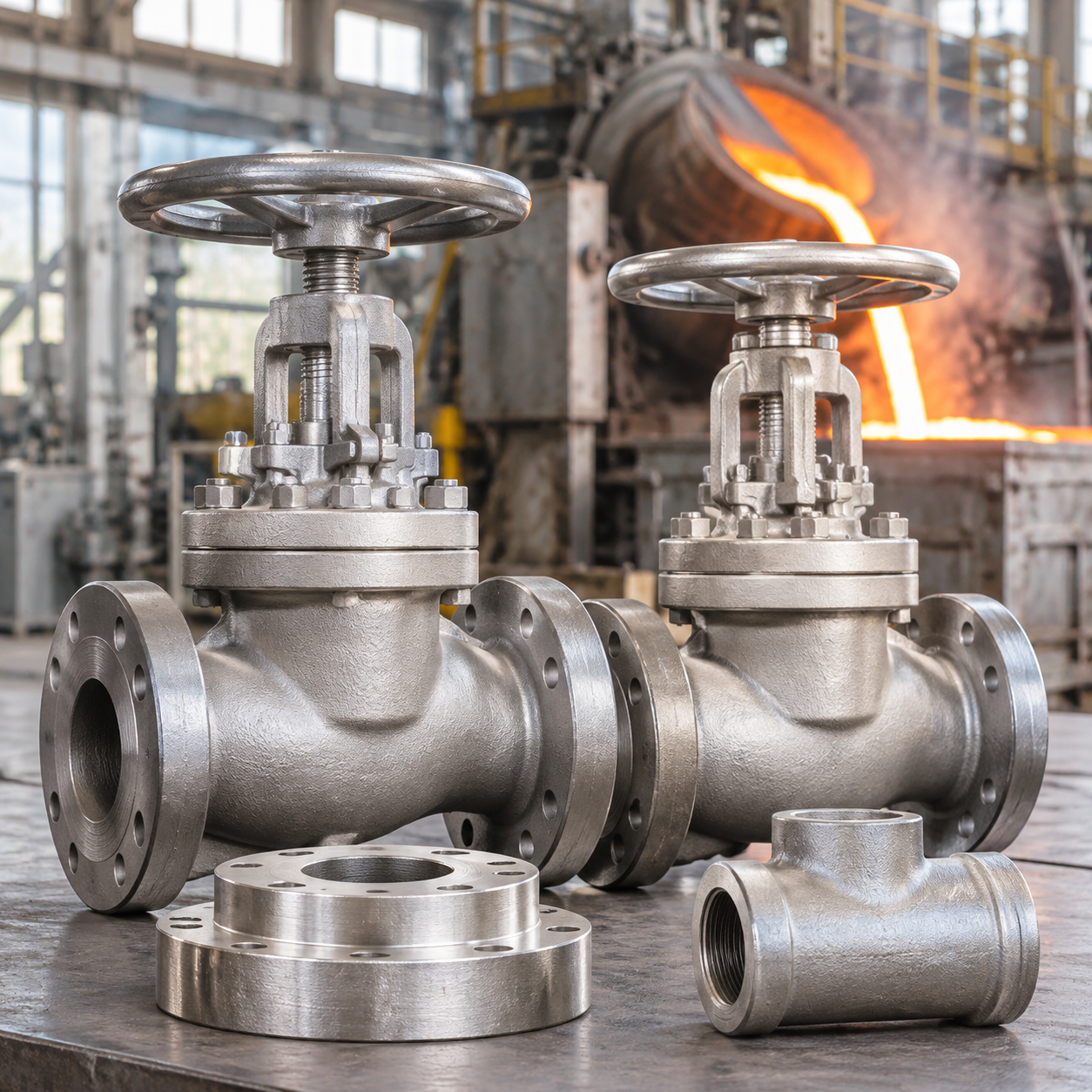
That single-sentence summary hides the two variables that decide your part's life: carbon content and molybdenum. Carbon affects how much chromium stays in solution after welding; molybdenum affects how the alloy behaves in chloride environments. Buyers who treat the two grades as interchangeable because both are "stainless" are the ones who end up with pitted valve bodies or cracked weld heat-affected zones 18 months into service. The photo above shows typical CF8 and CF3M castings side by side—visually identical, metallurgically different.
Carbon: The Difference That Shows Up After Welding
The carbon ceiling is where the grades diverge first. CF8 allows up to 0.08% C; CF3M caps carbon at 0.03%. When austenitic stainless is heated into the 425-870°C range—exactly what happens in a weld heat-affected zone—carbon above roughly 0.03% combines with chromium to form chromium carbide at grain boundaries. That strips chromium from the adjacent metal, and those chromium-depleted bands become preferential corrosion paths. CF3M's lower carbon leaves too little carbon available to form meaningful carbide networks, so the as-welded structure stays far more corrosion-resistant without a post-weld solution anneal.
For buyers, this translates into a fabrication question, not just a material question. If your CF8 casting is welded—say a pump casing with a welded flange or a valve body with a weld-repaired area—you should either specify a post-weld solution anneal (typically heat to about 1040-1120°C and rapid cool) or accept reduced corrosion resistance in the heat-affected zone. CF3M usually lets you skip that step, which is why it dominates welded assemblies. One caveat: low carbon does not make CF3M immune to sensitization if it is held in the critical range for very long, and it does not improve strength—CF3M is generally slightly softer and lower in yield strength than CF8, so do not swap grades on a pressure-containing part without checking the design margins.
Corrosion: Where Molybdenum Earns Its Premium
Molybdenum at 2.0-3.0% is the second differentiator, and it is the one that decides performance in chlorides. CF8 (304 family) handles fresh water, mild atmospheric exposure, many food-contact and dairy applications, and dilute organic acids. It is a poor choice for seawater, de-icing salts, chloride-bearing process streams, or any environment where the part stays wet and stagnant. CF3M (316L family) resists pitting and crevice corrosion in chloride environments substantially better and is the default for marine-adjacent, chemical-process, and pharmaceutical service where cleaning agents contain chlorides.
The practical test is your service environment, not the grade name. Ask: what is the chloride concentration, what is the temperature, and will the surface stay wetted or cycle wet-dry? Warm, stagnant, high-chloride conditions are the classic pitting recipe that separates the two grades. A buyer specifying CF8 for a brackish-water pump because it is cheaper is trading a modest per-kilogram saving for a much shorter service life. The chart below shows typical relative pitting resistance for the two grades alongside the base 304/316 families—use it as a directional screen, then confirm against your actual chemistry and temperature with the foundry's material certificate.
Typical Applications and a Specification Checklist
CF8 shows up in general-purpose pump casings, water-treatment valves, food and beverage fittings, architectural hardware, and non-chloride process equipment—anywhere the part sees mild corrosives and either is not welded or can be annealed after welding. CF3M dominates chemical-process valves and pumps, pharmaceutical and biotech skids, desalination and marine hardware, pulp and paper equipment, and welded assemblies that cannot be heat-treated after fabrication. Both grades are routinely specified to ASTM A351, with A351/A351M the reference standard most Chinese foundries work to.
Use this checklist before you release a purchase order, and put the answers on the drawing so the foundry quotes and inspects against the same requirements.
Cost, Availability, and What to Put on the Drawing
CF3M carries a premium over CF8 because of the molybdenum addition and tighter carbon control, and that premium is real but usually modest relative to the finished part price—machining, testing, and logistics typically dominate the cost of a cast component. The bigger cost risk is specifying CF8 where service demands CF3M and paying for premature replacement, or specifying CF3M everywhere and accepting longer lead times and higher material cost on parts that never see chlorides. Match the grade to the environment, not to habit.
On the drawing, state the grade and standard explicitly—"ASTM A351 CF3M" or "ASTM A351 CF8"—along with any post-weld heat treatment, the welding procedure, and the test requirements you need: chemical analysis, tensile properties, and, for critical chloride service, a corrosion or intergranular corrosion test agreed with the foundry. Ask for the heat-number traceability and the material certificate with each lot. The chart below shows typical relative material cost between the grades, which is useful for budgeting but should never be the deciding factor on a corrosion-critical part.
Frequently Asked Questions
Can I substitute CF8 for CF3M if the part is not welded?
Only if the service environment is genuinely chloride-free and non-stagnant. CF3M's molybdenum is what protects against pitting and crevice corrosion in chlorides; welding is a separate issue. If your part sees seawater, de-icing salts, or chloride-bearing cleaning agents, stay with CF3M regardless of welding.
Does CF3M need post-weld heat treatment?
Usually not. Its 0.03% carbon cap limits chromium carbide formation in the weld heat-affected zone, so most CF3M assemblies can go into service as-welded. CF8 typically needs a solution anneal after welding if full corrosion resistance in the heat-affected zone is required.
What should I put on the drawing to avoid grade mix-ups?
State the grade and standard explicitly, for example "ASTM A351 CF3M," plus any post-weld heat treatment, welding procedure, and test requirements. Require the material certificate with heat-number traceability for each lot, and confirm the foundry will supply chemical and tensile results against A351.
Looking for a reliable casting supplier? Request a quote from Intercontinental Casting — our engineering team replies within one business day.